
|
By Katie Vaccaro Mantis shrimp are small, unique crustaceans that live in temperate to tropical waters across the globe. They are known for their bright colors, feisty behavior, and their ability to move with astonishing speed and force, rivaling that of a .22 caliber bullet. Mantis shrimp club-like appendages move so fast that cavitation bubbles (bubbles of low pressure that create a shock wave when they collapse) are created to stun prey. 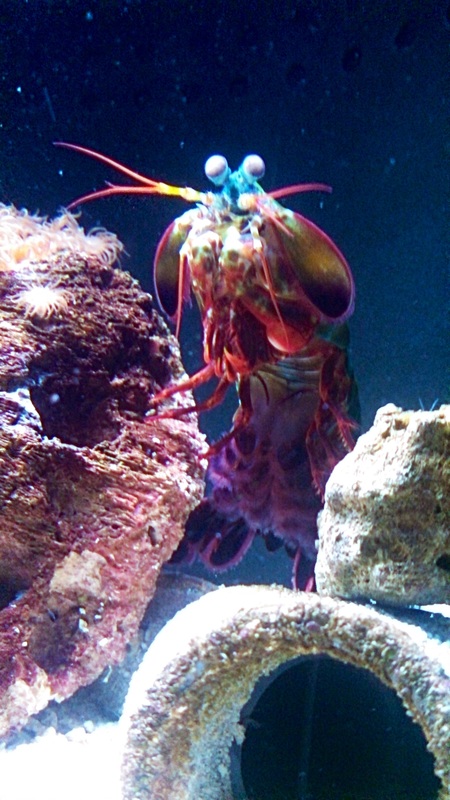 Hello friends! I am a Peacock mantis shrimp, Odontodactylus scyllarus! Photo by: K. Vaccaro As if these critters aren’t cool enough, mantis shrimp also possess the most complex vision in the animal kingdom. Humans see through 3 photoreceptors – cones that pick up red, blue, and green light. Contrastingly, mantis shrimp see through upwards of 16 photoreceptors – 12 for color and 4 for filtering and polarized light. The photoreceptors are lined up in 6 rows in the middle of a mantis shrimp’s compound eye called the “midband”. Through several studies, the number of visual pigments (the 12 photoreceptors that see color) has been shown to be constant in each species, regardless of habitat, location, or depth (Cronin et al 2002a; Cronin et al 2002b). However, a recent study characterized opsins (proteins necessary for vision) and found that while visual pigments are constant, opsins are highly variable between species and that multiple opsins can be found in each visual pigment (Porter et al 2009)! 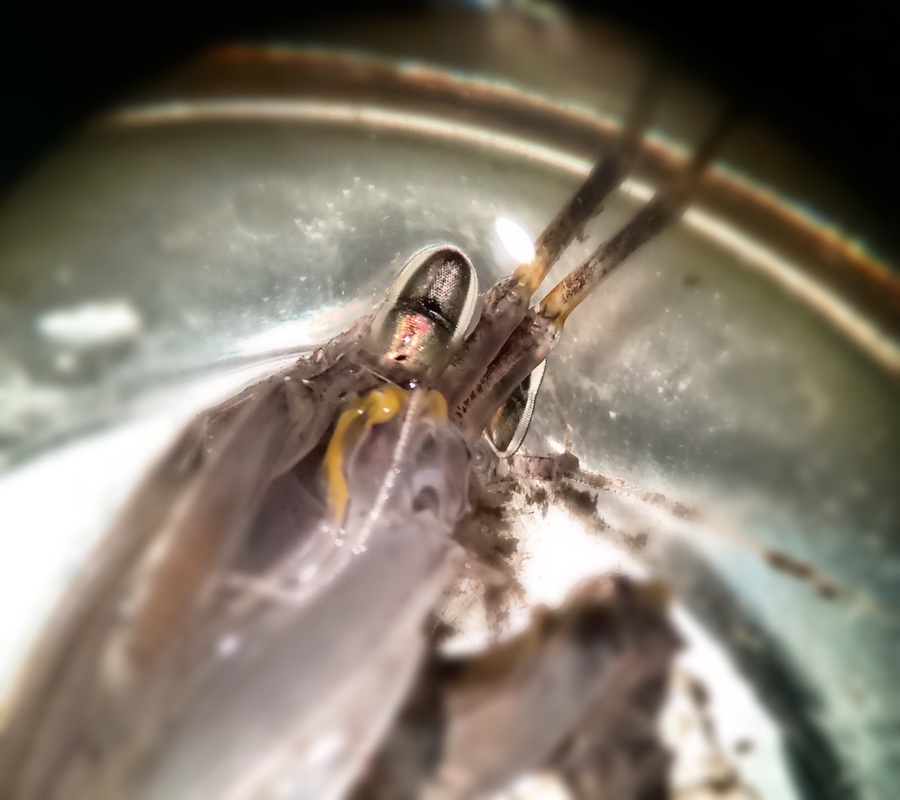 Squilla empusa from Gulf of Mexico, showing off its compound eyes and midband. Photo by: K. Vaccaro Here is where my research comes in. My thesis involves characterizing more opsins across different species of mantis shrimp. I am interested in determining if the environment plays a role in how many/which specific opsins are expressed in selected species such as the Sea scorpion (Squilla empusa) and the Common mantis shrimp, (Pseudosquilla ciliata), among others. Squilla empusa is a common species that is found in sand burrows across the Gulf of Mexico and in the Western Atlantic Ocean. Pseudosquilla ciliata is another common Gulf of Mexico species that also is found in the Pacific in both sand burrows and coral rubble. These two species are fantastic examples of mantis shrimp that inhabit a wide range of depths (S. empusa: 0-150 meters; P. ciliata: 0-80 meters) and habitats. Are different opsins expressed at different depths, due to varying levels of light? Do mantis shrimp that live in busy coral communities express more opsins than those living in flat, sandy burrows? If the expression of opsins is variable within a species, how quickly do mantis shrimp adapt to seeing in different environments, if at all? These are the questions I hope to answer, so check back for updates in the future! 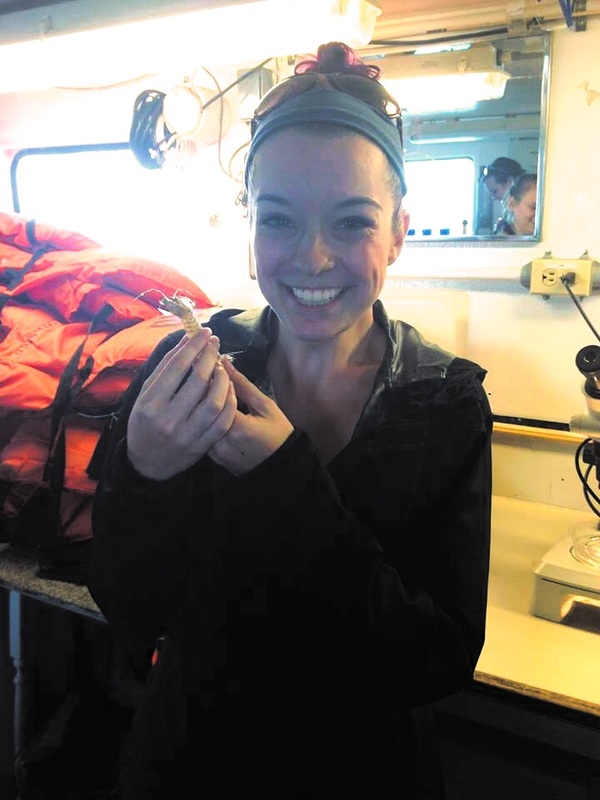 Here’s a photo of me, holding the same Squilla empusa from the above picture (Don’t try this yourself)! Photo by: N. Vantassel Literature Cited
Cronin T, Caldwell R, Erdmann M (2002a) Tuning of photoreceptor function in three mantis shrimp species that inhabit a range of depths. I. Visual pigments. Journal of Comparative Physiology A: Sensory, Neural, and Behavioral Physiology 188:179–186. doi: 10.1007/s00359-002-0291-0 Cronin T, Caldwell R, Erdmann M (2002b) Tuning of photoreceptor function in three mantis shrimp species that inhabit a range of depths. I. Visual pigments. Journal of Comparative Physiology A: Sensory, Neural, and Behavioral Physiology 188:179–186. doi: 10.1007/s00359-002-0291-0 Porter ML, Bok MJ, Robinson PR, Cronin TW (2009) Molecular diversity of visual pigments in Stomatopoda (Crustacea). Visual Neuroscience 26:255–265. doi: 10.1017/S0952523809090129
1 Comment
Patience
11/15/2016 06:25:05 pm
I had no idea a little shrimp Could be so LIT. Leave a Reply. |
Janosik LabWelcome to our lab blog. Members of the lab will write posts about current research, science or topics of interest. We look forward to your comments! Archives
December 2017
Categories |
 RSS Feed